Hope for Paws PH: An Advocacy on Local Animal Cruelty

About
Hi, I'm Cooper! My friends and I are here to help. What would you like to know?
My name is Yano! Let's define animal cruelty.
DEFINITION
Animal cruelty is any intentional and/or repeated behavior causing physical or psychological distress in animals including, but not limited to, bringing unnecessary pain, suffering, distress, or death on an animal (Johnson, 2018). There are two general categories:
PASSIVE / NEGLECT:
Passive animal cruelty may be done intentionally (gross neglect), or out of ignorance (simple neglect). This can take the forms of poor food and water availability, poor working conditions, lack of activity, and constructive human contact (FourPaws, 2019).
ACTIVE:
Active abuse goes beyond neglect and includes inflicting painful injuries through physical abuse like beating, pain, training based on punishments, making animals perform unnatural activities, exploitation for entertainment like racing and fighting, death or inhumane killing, and even bestiality (FourPaws, 2019). Other forms include ritualistic abuse and blood sports (Mogbo et al., 2013).
LINKED FACTORS
Yani here! Although animal cruelty is a problem on its own, it is also rooted in different factors that affect its continuous prevalence. Within these factors, are other problems linked to animal cruelty. Let's ask Jewel and Ruben to help us walk through it.
ECONOMIC FACTORS
Numerous activities involving animal cruelty brings income to businesses and individuals in the Philippines. A few examples of these include sabong or cockfighting (Tacio, 2017), illegal dog fighting (Manabat, 2012), and illicit animal trade (Enano, 2019). Animal fighting shows and tradings are examples of how the Philippines and other countries continue to participate in animal cruelty because of opportunities for obtaining a larger income on both private and public scales.

CULTURAL FACTORS
At present time, more than thousands of dogs and cats are killed annually in the Philippines. The Philippine dog meat trade is mainly based in the province of Benguet, located in Northern Luzon. The presence of at least 25 dog and cat meat restaurants are distributed across areas like Benguet, Laguna, Pangasinan, and Batangas (Dacanay, 2012).
Cockfighting is also related culturally as it is a common pastime in the country. Almost every village in the Philippines has a cockpit where two cocks fight against each other and often shed blood, hence being called a blood sport by most (Day 2018). With the sport being deeply embedded in the country’s culture; this activity is normalized rather than being seen as deviant, making it harder to combat.
THE ADVOCACY
I'm Cream! Let's talk about our advocacy.
“Hope For Paws”, the name of this advocacy, focuses on its aims to help restore and provide a better future for abused and neglected animals in the country, along with a better-informed audience equipped with helpful and significant knowledge that can contribute to this future.
MISSION:
“To engage a more informed, compassionate, and active audience that can help in bringing a better future for abused animals.”
VISION:
“Hope for Paws envisions to advocate for all animals to live a life free from cruelty and hardships.”

importance
Hello, I'm Kerber! Now, why is it important to talk about such a topic?
Although the public seldom hears news concerning animal cruelty, instances of animal abuse are still present in the country. In a day, the Philippine Animal Welfare Society (PAWS), an animal welfare NGO and the country's leading advocate for the humane treatment of animals, receives about 40 reports on animal abuse happening within the country (Boncocan, 2012). A quick search you can do on recent news reports are also proof that animal cruelty is still a significant topic of concern in the country.
Since animals have limited capabilities to help and defend themselves from their aggressors, people have an elevated capacity to provide help. But this advocacy is not only in need of people, but of those who are informed, compassionate, and active. We must strive to be their voice.

HOW TO HELP
The name's Ash! Here are a few ways on how you can help.
You can start out by sharing this link to people you know. Putting this link on your social media accounts' stories, bio, or anywhere visible to others will also be a big help. This way, we can reach more people and hopefully educate them on the issue of animal cruelty, its importance, and how they can help, too!
Another way to help is to reach out or donate to your local animal welfare NGOs. A good example of this is PAWS. They accept donations in kind, and through bank transfers. They also have a GCash account that you can donate to if you have no means of banking yet. You can visit their website for more details.
Should you ever want to take care of your own pets, please adopt from shelters and pounds instead of buying. Buying animals mostly comes from illegal pet sellers and breeders where female animals are only used for breeding purposes and given no medical help. Once unable to reproduce, they are discarded like useless objects. Furthermore, having your pets spayed or neutered also helps lessen the production of stray animals that could also undergo animal cruelty.
It shouldn't stop there of course! You can continue to educate yourself through research, or by checking out any additional information involving animal cruelty. Let's stay informed, compassionate, and active!
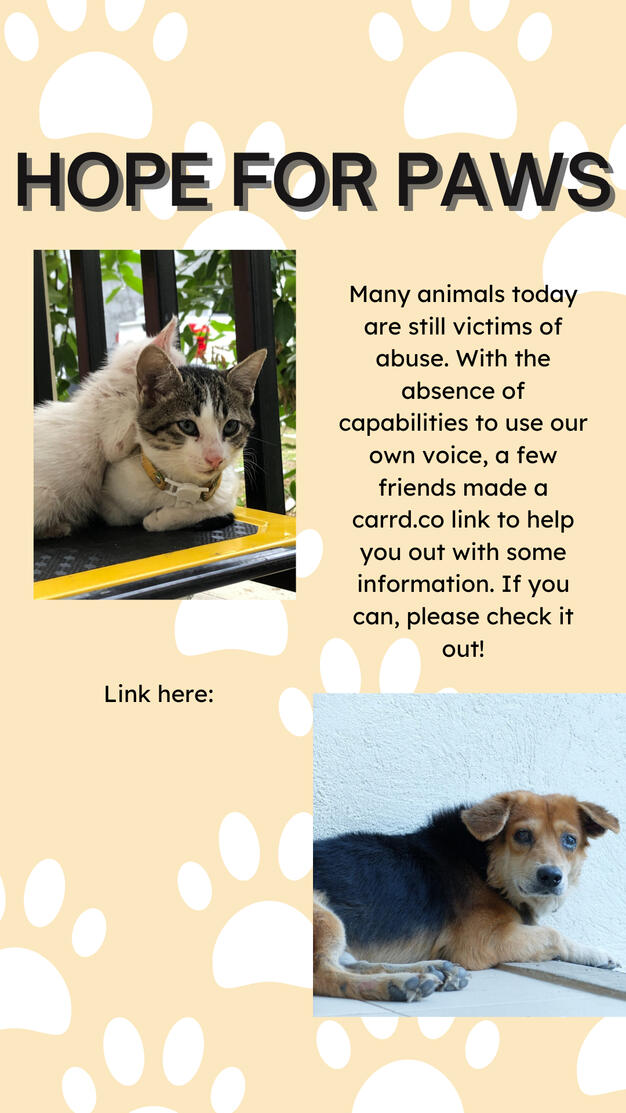
Here's a story template you can use. Feel free to use a different template. You can include your pets too!
SOURCES
Pierre and Cream again! Before you leave, here are the sources we used. Feel free to check them out too. Thank you!
Boncocan, K. (2012). PAWS gets about 40 reports of animal abuse daily.
INQUIRER.net. https://newsinfo.inquirer.net/310613/paws-gets-about-100-
reports-of-animal-abuse-daily.
Dacanay, B. (2012). About 290,000 dogs eaten as food every year in the
Philippines. Philippines Gulf News. https://gulfnews.com/world/asia/philippines/
about-290000-dogs-eaten-as-food-every-year-in-the-philippines-1.1045001.
Day, P. (2018). Cockfighting thrives in full view in Philippines.
https://asia.nikkei.com/Life-Arts/Life/Cockfighting-thrives-in-full-view-in-Philip
pines2.
Enano, J. (2019). PH losing P50B a year to illegal wildlife trade. Inquirer News
PH losing P50B a year to illegal wildlife trade Comments. https://newsinfo.inquirer.net/1155025/ph-losing-p50b-a-year-to-illegal-wildlife-trade.
FourPaws. (2019). What cruelty feels like for animals themselves.
https://www.four-paws.us/campaigns-topics/topics/companion-animals/preventcrueltytoa
nimals/what-cruelty-feels-like-for-animals-themselves.
Johnson, S. A. (2018). Animal cruelty, pet abuse & violence: the missed dangerous
connection. MedCrave. https://medcraveonline.com/FRCIJ/FRCIJ-06-00236.pdf.
Manabat, J. (2012). Illegal dog fighting busted in Laguna. ABS-CBN News.
https://news.abs-cbn.com/nation/regions/03/31/12/illegal-dog-fighting-busted-laguna.
Mogbo. (2013). (PDF) Animal Cruelty: A Review.
https://www.researchgate.net/publication/258342070AnimalCrueltyAReview.
PETA. (2019). Animal Abuse and Human Abuse: Partners in Crime.
https://www.peta.org/issues/animal-companion-issues/animal-companion-factshee
ts/animal-abuse-human-abuse-partners-crime/.
Scheffer, G. (2019). Animal abuse: A close relationship with domestic violence.
https://ddd.uab.cat/pub/da/daa2019v10n2/daa2019v10n2p56.pdf.
Tacio, H. D. (2017) Culture And Arts: This sport is called cockfighting. Edge Davao.
https://edgedavao.net/culture-arts/2017/01/31/culture-arts-sport-called-cockfighting/.
SOCIAL FACTORS
Evidence from psychiatry and criminology shows that there is no limit to those who inflict cruelty on animals. In reality, a lot of them can turn their cruelty towards human beings (PETA, 2019). In addition, there is an increasing awareness that domestic violence, child abuse, and pet abuse commonly exist in the same households. In cases of domestic violence, child abuse, and elder abuse, animal cruelty is a way for the aggressor to silence or threaten their victims, and is also a way of showing them what they are capable of; implying that it can also happen to their victims (Scheffer, 2019).